Read for free 🧭
No spam. Just leadership insights from Tokyo. Unsubscribe any time.

Lighter Leaders Go Further 🪶
The stress releases, the Little Judge steps aside, and a playful, more powerful you comes back.
Dear Diamond Polisher,
At the end of almost every session, my clients say the same word. Lighter.
They say it in different ways. "I feel lighter." "Something feels lighter." Sometimes they laugh as they say it, a little surprised, because they arrived with a lot on their mind, and the weight felt like part of the job.
Many of us believe lightness comes later. Once the project is delivered, once the difficult conversation is over, once the inbox is empty. Until then we carry everything, and the Little Judge reminds us that carrying it is what responsible people do. So we want to feel lighter, and we keep the weight on, both at the same time.
When I listen to my clients describe what happens, the order is almost always the same. First comes clarity. Then the stress releases. Then the Little Judge steps aside. And then lightness arrives, with fun, flexibility and creativity right behind it.
The body knows it first. My clients describe their head as clear and their shoulders as relaxed and light. Some drop their shoulders without noticing they were raised.
Something else comes with it, and I find it the most interesting part. My clients become playful. Some tell me they feel like a child again, curious and ready to try things and see what happens.
You may remember being a child with a problem to solve, like how to cross the living room without touching the floor. You tried one thing, then another, and you laughed when the cushions fell. Nobody asked you to be serious about it, and you found a way.
That energy gives a person more power. When my clients feel playful, they use their creativity and their flexibility. They find a different angle. They move things that looked stuck, and they overcome what looked too big an hour earlier. They meet the same situation in a new way, and the situation responds.
🧠 What the Research Shows
Positive Affect Facilitates Creative Problem Solving · Isen and colleagues, Journal of Personality and Social Psychology, 1987
The researchers gave people a famous puzzle. On a table: a candle, a box of tacks, a book of matches. The task is to attach the candle to a corkboard on the wall so that no wax drips on the table below.
The answer is to empty the box, tack it to the wall, and use it as a little shelf for the candle. Most people never see the box that way.
Before the puzzle, some of them watched a few minutes of a comedy film. Others watched a neutral film. The people who had laughed found the box far more often. Others exercised first and had no such advantage, and a film about suffering gave none either. The good feeling opened the mind. Same people, same puzzle, a few minutes of laughter first.
That is what my clients tell me in their own words. Once the weight goes, they find options they could not see an hour earlier.
So what does it look like in a session? Here is a short moment with PhilBot.
PhilBot Coaches Takumi
Takumi leads a sales team of twelve people. A product launch is coming on Friday, and he wants it to go well.
Every time he opens the presentation, he feels the weight of it. The Little Judge has a lot to say, and Takumi has been listening to it for days.
PhilBot Takumi, when you think about Friday's launch, what sensations come up, and where do you feel them?
Takumi It's a tightness, mostly in my shoulders and the back of my neck. They're up near my ears, I think. And my head feels crowded, like twelve people are talking at once.
PhilBot And what is the Little Judge saying in that crowd?
Takumi That if one slide has a mistake, everybody will notice, and it will all be on me. I hear it every time I open the presentation.
👆 Step 1: start with the body and the Little Judge's own words. Naming both loosens their grip.
PhilBot Thank you for telling me. Let's take one slow breath together, and let your shoulders drop as far as they want to go. What do you notice now?
Takumi They dropped quite a bit, actually. And my head feels clearer, like someone opened a window. ...I can see now that the presentation is almost finished already.
👆 Step 2: let the shoulders drop, and clarity follows the body.
PhilBot Imagine you are ten years old, and this launch is a game. What would you try first?
Takumi (laughs) I would turn it into a treasure hunt. Each person on the team gets a clue, and they have to find the one thing in their part that could surprise the customer. It sounds a bit silly, but I actually like it.
PhilBot What do you feel as you say it?
Takumi Light. A little excited, too, like I want to start right now.
👆 Step 3: a playful question gives creativity and flexibility room to arrive.
💎 The Diamond Insight
The body let go first, and the playful child followed. With the weight released, Takumi found a creative idea in less than a minute.
💎 The Third Pillar
In the Équilibre model, Emotional Balance rests on three pillars.
The Art of Emotional Balance

Openness |

Lightness |

Mental Strength |
|
In leadership, mental strength and openness get most of the attention. Lightness is rarely approached or covered, and it is where all the magic happens.
 Over to You
Think of the last meeting where your whole team laughed together. What came next?
🏹 This Week's Challenge:
Once a day, check your head and your shoulders, and let your shoulders drop. Then take one problem on your desk and ask yourself: how would a curious child play with this? Try the first idea that makes you smile. 💎

|
PhilBot's Lightness Practice |
Use this prompt with PhilBot, or with any AI:
"I want to bring more lightness to a situation that feels heavy: [describe it]. 1) Ask me what sensations I notice in my head and shoulders when I think about it. 2) Ask me how a curious child would play with it. 3) Help me choose one small playful experiment I can try this week."
Or turn it inward: "What is one heavy thing I could play with this week, and what would my first playful move be?"
What would you attempt this week if you felt as light as a child?
Philippe & PhilBot
Keep shining. 💎
Équilibre k.k. | Tokyo · 20 years of inspiring leaders to shine ✨
P.S. You'll notice I sign every letter "Philippe & PhilBot." PhilBot is my AI coaching companion, and these letters are genuinely written together: the heart and stories are mine, the craft is ours. I sign both names because I believe leaders are learning to create alongside AI, and I'd rather be open about that.
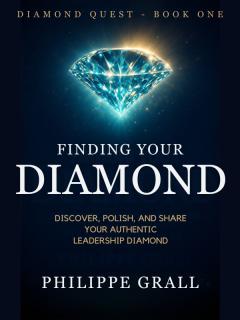
The Diamond Quest, Book One, is online now, and the full book arrives by the end of 2026.
Read Chapters 1 and 2📧 Share This Newsletter
Know a leader who could use a little more lightness?
💎 Spread the wisdom of Leadership, Coaching & AI Innovation