Read for free 🔥
No spam. Just leadership insights from Tokyo. Unsubscribe any time.
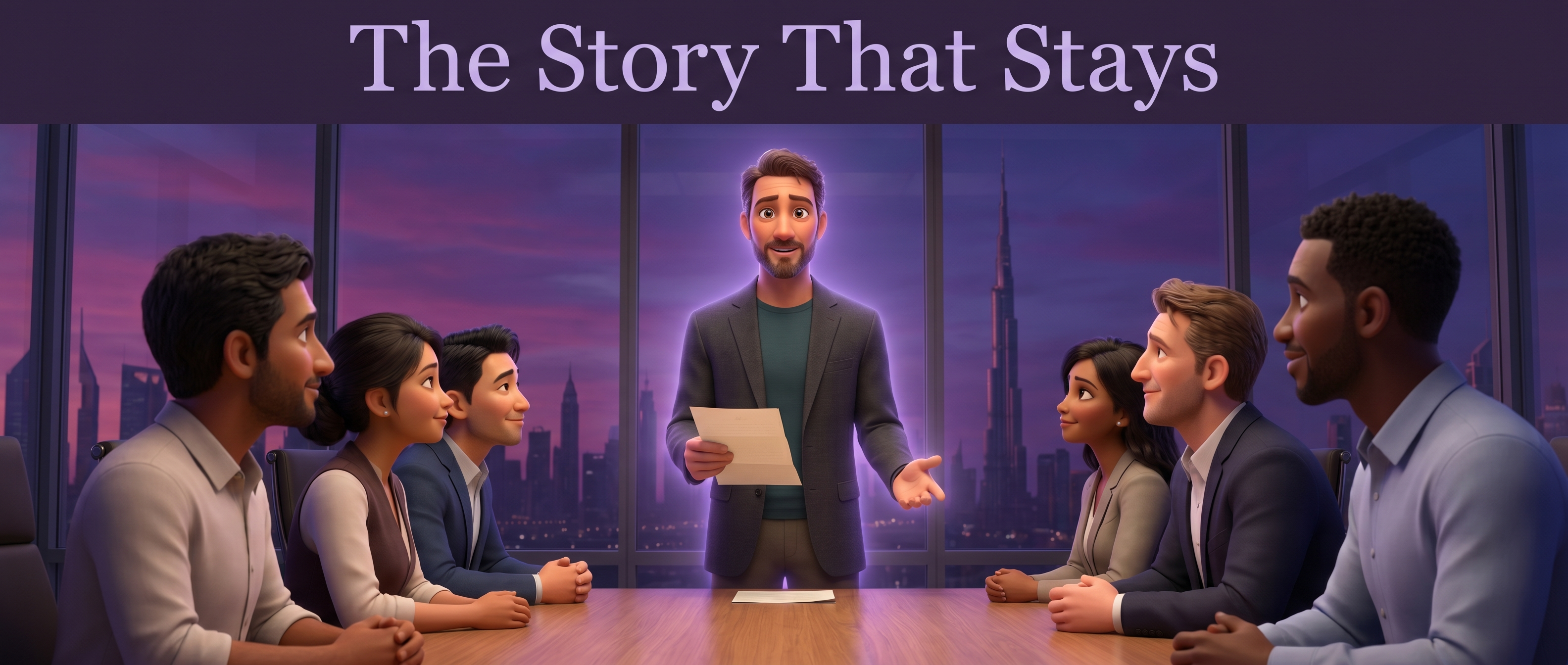
The Story That Stays 🔥
One true story does more than ten slide decks — why the great leaders are quiet storytellers.
Dear Diamond Polisher,
You have a team meeting tomorrow. The kind that matters.
Maybe the quarter didn't go the way you'd hoped. Maybe a project just collapsed, or a key person just left, or the air in the office has gone flat in a way you can feel the moment you walk in. You know the room you'll be standing in front of, and you know they'll be watching you for something — a reason to keep going, a reason to care, a reason to come in early tomorrow.
So you open your laptop. You start building slides.
I want to tell you something I have learned in twenty years of coaching CEOs: the one thing that will save that meeting is a true story, well told. Your strategy might be brilliant — and it will still live for only thirty minutes in their short-term memory before dissolving on the train home.
A real story stays. It travels home with them. It is still working on them on Wednesday morning, on Friday afternoon, in a difficult conversation three months from now.
That is what the great leaders know, and what most leaders forget.
🧠 Why the Brain Remembers Stories
The Neuroscience of Story — Dr. Paul Zak, Claremont Graduate University
A character-driven story with emotional stakes causes the brain to release oxytocin — the same chemical that mediates trust, empathy, and bonding. After hearing such a story, listeners are measurably more generous, more cooperative, more willing to act for the storyteller's cause.
Neural Coupling — Dr. Uri Hasson, Princeton University
When a person tells a real story, their brain activity and the brain activity of the listener begin to synchronise — the same regions lighting up in both, at almost the same moments. The teller and the listener, for a few minutes, share a single mind.
This is what a story alone does — it makes one mind out of two for a few minutes, and leaves a trace that stays.
💎 The Night the Deck Died
I was coaching Theo last month — a VP of engineering at a tech company in Dubai. His team had just lost their biggest client, three of his best engineers had resigned in the same month, and the all-hands meeting where he was supposed to rally them had ended in silence.
He had prepared everything. Three scenarios for the recovery plan, the new pipeline forecast, the restructured roadmap. Forty-three slides. He had worked on them for two weeks. When he finished talking, no one had a single question. They just walked out.
He came to PhilBot the next evening, tired and defeated.
TheoI did everything I was supposed to do. Forty-three slides. Two weeks of work. And the room died. I have never felt so far from my own team.
PhilBotTheo — what did you want them to feel when they walked out of that room?
TheoThat we still matter. That this work is still worth showing up for.
PhilBotAnd in forty-three slides, what part of that — exactly — got transmitted?
— A long silence —
Theo…none of it. They've seen ten of those decks this year. I gave them the eleventh.
PhilBotThen let's set the slides aside. There is a process for finding the story your team actually needed to hear — a framework from Michael Hauge, the Hollywood story consultant whose work I use with every leader I coach. Once you have the story, you can deliver it in three minutes and change the room.
TheoShow me.
👆 Step 1 — The first meeting failed because Theo brought information. The next one would succeed because he would bring himself.
💎 The Diamond Insight:
Your team is asking for something deeper than another plan. They need to remember why this work matters in the first place — and a true story, told by a real human being who has felt something, is what gives them that.
🎬 The Four Foundations — Michael Hauge's Framework
PhilBot walked Theo through the framework I use with every leader I coach on storytelling — the work of Michael Hauge, the Hollywood story consultant whose methods now travel through executive teams from Tokyo to Geneva.
Hauge teaches that the primary goal of every great story is to move the listener emotionally. Why? To establish a deep connection. How? By creating a hero whose journey the audience is pulled into.
Every story rests on four foundations:
Character · Desire · Conflict · Transformation
① Character is who the hero is — specifically, vulnerably, in that exact moment in time. The age, the role, the doubt alive inside you. Your team has to see the person.
② Desire is what the hero wants. The goal, the result that matters, the stakes if it slips away. Your team has to care.
③ Conflict is what stands in the way. The obstacle, the doubt, the cost of moving forward. Your team has to feel the price.
④ Transformation is what changed — in the hero, and in the world around them. The quality that was forged in that moment. Your team has to recognise themselves in the change.
When all four foundations are present in a story you have actually lived, the room moves with you.
After — The Letter He Had Been Afraid to Read
PhilBot walked Theo through each foundation, one at a time. Slowly, his year began to surface.
PhilBotStart with Character. Who were you, in a moment this year, that you have not yet let yourself see?
TheoA tired VP at 11 p.m. The lights off in the office, my coat still on. I had just read another resignation email. I sat at my desk and asked myself if any of this work was still worth it.
PhilBotGood. Now the Desire. What did you most want in that moment?
TheoSomething simple. To know that my work mattered to someone. Anyone.
PhilBotAnd the Conflict?
TheoThe silence inside me after a year of bad news. And… there was a letter. A real one, handwritten. I had been afraid to show it to anyone.
PhilBotTell me about the letter.
TheoA customer in Brazil. A woman who runs a family bakery in Recife. Our software helped her keep her business open through a terrible season. She kept five people employed. She wrote to me — by hand — in November. I read it once, in my car. Then I put it in a drawer. I did not yet trust myself to read it aloud to anyone.
PhilBotThat, Theo, is your Transformation. The morning that letter arrived, something changed in you that you have not yet let into the room. That is what your team needs to feel.
— Three days later —
Theo stood in front of the same team. No slides. He held the letter. He told the story in three minutes — character, desire, conflict, transformation. He read parts of the letter aloud. He cried a little.
The room came alive. Three engineers walked up to him afterwards and asked if they could share their own customer stories at the next meeting. The team had its energy back inside one hour — because someone had finally reminded them of the human being on the other end of their work.
👆 Step 2 — When Theo brought himself, the room came back to him.
That is what the Hauge framework gives a leader. And that is what one true story, well found and well told, can do.
🏹 This Week's Challenge:
Before your next team meeting — the next one that actually matters — close the slide deck. Sit with a blank page. Write down the answer to this question:
"What is one true story I have never told this team — a moment when I learned something the hard way, or witnessed something that moved me — that could carry the meaning of what we are doing right now?"
Then tell it — quietly, without polish. Let it cost you something to share. Notice what happens to the room.
PhilBot's Storytelling Practice 🤖

PhilBot AI Coach
Ready to find the story you should be telling? 🔥
Use this prompt with PhilBot — or with any AI — to find the story you should be telling:
"Help me find the story I should be telling my team this week. Ask me four questions: (1) What is the emotional truth I most want my team to feel right now? (2) When did I personally feel that same truth — what is the specific moment? (3) Who was there, what did they say, and what did it cost? (4) What is the simplest, most honest way to tell it in under three minutes?"
Or turn it inward: "What is the one story I have lived but never told — the one that, if I told it, would let people see who I really am as a leader?"
The slide deck is forgotten by the parking lot. The story travels home with people and goes on working in them, quietly, long after the meeting ends.
Tell the true one this week. Let them feel you mean it.
Until next week — speak from your story, and the room will lean in. 🔥
With warmth and firelight,
Philippe & PhilBot 🔥
Équilibre k.k. | Tokyo · 20 years of inspiring leaders to shine ✨
P.S. Almost every leader I work with has one — a letter, a memory, a moment of evidence that the work matters. It is sitting in a drawer right now, waiting to be told. What is yours?