Read for free ✨
No spam. Just leadership insights from Tokyo. Unsubscribe any time.
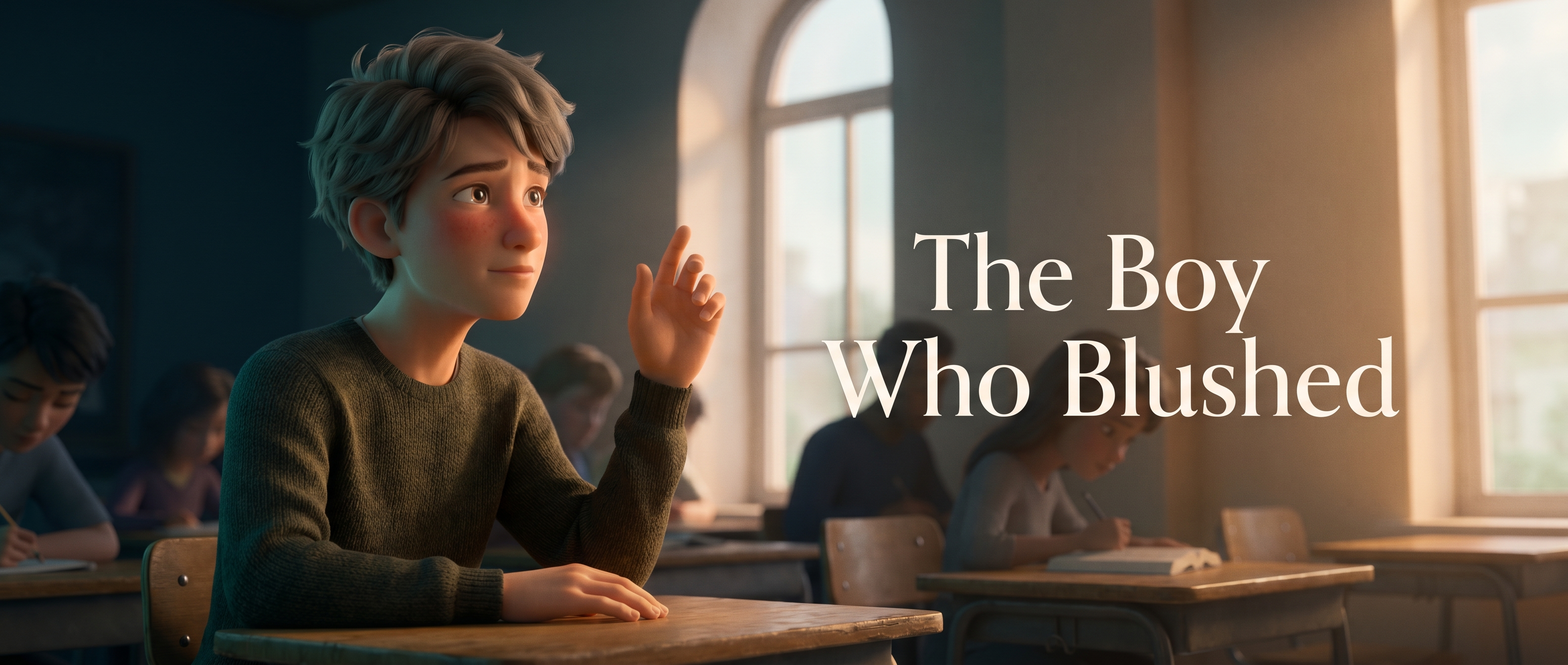
The Boy Who Blushed 🌱
The fierce inner judge a young person carries isn't a flaw in their character — it's a growing brain, and there's an inner game that quiets it.
Dear Diamond Polisher,
This week I want to write to a young person who probably isn't reading this. A son, a daughter, a niece, a nephew — the one who's gone quiet at dinner, who knows the answer in class and keeps their hand down anyway.
So let me start by telling you about a boy I knew very well. Me.
When I was fifteen, I had a judge living inside me, and he never slept. You sounded stupid. They noticed. And he had a favourite trick — he could make my whole face burn red in front of people. The cruel part is that I didn't even need someone to be looking. The thought that they might was enough.
Nobody ever explained what was happening, so I decided the thing was me. I believed for years that I was simply built wrong. I wasn't. Something real was happening, and it had a name, a reason, and — the part I most wish someone had told me — an end.
🧠 The Loudest Years Have a Reason
Self-Esteem Across the Lifespan — Robins & Trzesniewski, University of California, Davis
An almost-universal shape: high in childhood, a dip through adolescence — sharpest for girls — then a steady climb across adulthood. The low you feel at fifteen is close to the lowest it will ever be. From there, for most people, it rises.
The Adolescent Social Brain — Blakemore (Cambridge) & Somerville (Harvard)
Adolescence is a sensitive period for the social brain — the regions tracking "what do they think of me?" are being rebuilt, and they run hot. A teenager feels everything at full volume while the prefrontal "dimmer switch" is still wiring itself into the mid-twenties.
So, for the teenager you love: the loud inner judge isn't a flaw in their character. It's the ordinary architecture of a growing mind — and the architecture finishes.
🔦 The Secret About Blushing
At Cornell, Thomas Gilovich had students wear an embarrassing t-shirt into a room of peers, then asked how many noticed. They were sure half the room had. The real number was about a quarter. He called it the spotlight effect — and the spotlight is mostly in our own head.
The blushing has a secret in the same family. Researchers who study the fear of blushing — Susan Bögels and colleagues — found the fire is fed by self-focused attention. The more a young person watches their own face, the hotter it burns. And the way out: gently move the attention outward, onto the task, onto the other person. When attention leaves the self, the blushing loosens its grip. Nobody told me the switch was in my own hand.
💎 PhilBot Coaches Noa 🤖
Noa is sixteen — funny with two close friends, silent everywhere else. There's a question in class Noa knows, but the hand stays down: I'll go red, everyone will see. Tonight, Noa types it to PhilBot.
Noa I hate putting my hand up. I go bright red and everyone stares.
PhilBot That sounds exhausting. Can I ask you something? Last week, when someone else in class went red or stumbled — what did you think of them?
Noa I... can't even remember anyone doing that.
PhilBot That's the whole secret. You can't remember because you weren't watching that closely — and they're not watching you that closely either. Everyone's starring in their own movie, worrying about their own scene.
Noa But my face still burns. That part's real.
PhilBot Completely real. And here's what researchers found: the more you watch your own face, the hotter it gets. So next time, give your attention a job somewhere else — the question on the board, the person you're answering. Let your eyes leave yourself for ten seconds, and see what your face does when you stop guarding it.
— The next day —
Noa I tried it. Answered one question, kept my eyes on the board the whole time. I still went a bit red... but it was less. And it was over in like five seconds. Nobody made a thing of it.
PhilBot That's it. That's the whole game, right there. You didn't get rid of the blush — you stopped feeding it your attention, and it shrank. Try it again tomorrow, and next week, and one day you'll notice the judge went quiet without you even deciding it should. That little win you just felt? That's the beginning of mastering the inner game.
👆 The judge feeds on attention. Turn it outward — and the first small try is where mastery begins.
💎 The Diamond Insight:
A young person's fierce inner judge isn't proof something is wrong with them. It's a loud, temporary feature of a growing brain — and it quiets. The spotlight they feel is mostly their own. And the heat of being watched cools the moment they stop watching themselves.
💡 The T.R.U.E. Inner Game
Four moves for the moment the judge gets loud. I named it T.R.U.E. — because each one points back toward the true self under the noise.
T — This is the Judge talking. Name the voice. It isn't you, and it isn't the truth — it's a habit of a growing brain.
R — Reality, not the spotlight. Ask: who will actually remember this tomorrow? Almost always, far fewer than it feels like.
U — Use your eyes outward. Put attention on the task, the question, the other person's face. The world is steadier than the mirror.
E — Even you deserve kindness. Talk to yourself the way you'd talk to a friend who'd just gone red. Kristin Neff (University of Texas at Austin) has shown self-compassion is one of the strongest protections a young person has against anxiety and self-criticism. Not softer — stronger.
🤍 And a Word for You, Watching
There's a particular ache in loving a young person who's struggling. You see it, you can't reach inside and lift it out, and your own inner judge leans in to whisper that you should be doing more — that somehow you're failing them.
Let me gently lift that off you. You don't have to fix this. Your steady presence — calm, unhurried, still there at dinner — is already doing more than you know. Guilt is just your own little judge borrowing the moment. Set it down. A young person doesn't need a perfect adult. They need one who stayed.
And when you do speak, the most powerful words you have are the simplest: me too. Tell them you were exactly like that — the blushing, the silence, the certainty that everyone was watching. Tell them it's so ordinary the science has a name for it, and that you came through it. Shame rarely survives being shared. The moment a young person learns they aren't the only one — and that the calm adult in front of them once felt every bit of it — the judge loses half its power.
🏹 This Week's Challenge:
Sometime this week, tell the young person a true story about a moment you felt small, watched, or red-faced at their age — and what you know now that you didn't then. Don't give advice. Just let them see the calm adult in front of them was once exactly where they are. Notice what happens to the space between you.
Try This with PhilBot 🤖
|
PhilBot AI Coach Use this prompt with PhilBot — or with any AI — to walk a young person (or your younger self) through a hard moment: "I'll describe a situation where I feel watched and judged. Walk me through T.R.U.E.: help me name the inner judge so I see it isn't me, reality-check how much people will actually notice, give me one thing to put my attention on instead of myself, and help me say one kind, true sentence to myself." Or turn it inward: "When I was a teenager, what did my inner judge always say — and what would I tell that kid now?" |
A gentle note: for most young people the loud judge softens with time and kindness. But if the voice in someone you love has turned truly cruel or constant, take it seriously together — a trusted adult, a school counsellor, a doctor. No one should face the harshest version of that judge alone.
The boy who blushed grew up to stand in front of rooms for a living. Pass this on. There's a young person who needs it now.
With warmth and hope for the young ones,
Philippe & PhilBot 🌱
Keep shining. 💎
Équilibre k.k. | Tokyo · 20 years of inspiring leaders to shine ✨
P.S. About the two names below: the writing and the conviction are mine — the boy who blushed was me. PhilBot is my AI coaching companion, built on Claude, who helps me with the research and the design. The heart is human; the polish, we share. 🌱